Scared to Drive on the Highway? How to Do It Step by Step
Updated 2026-10-18 · Sources last checked 2026-10-18 · Not yet reviewed by an expert
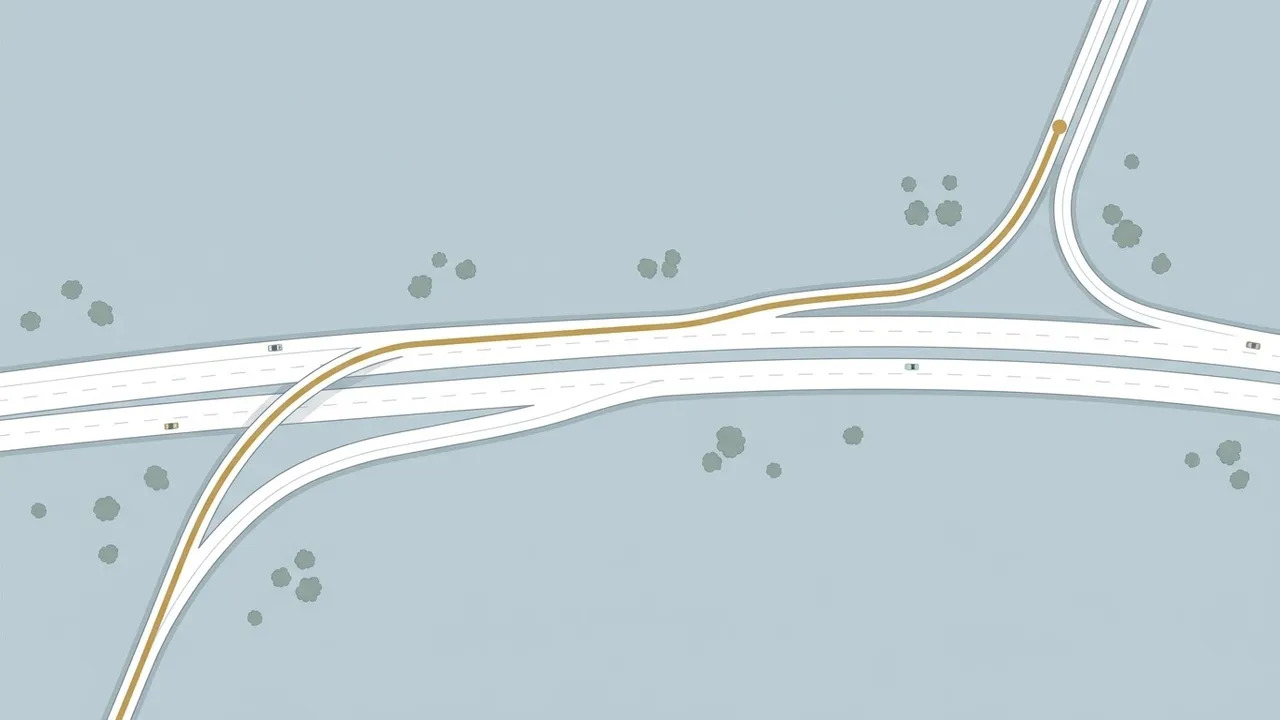
Illustration
If you are scared to drive on the highway, build up in small steps: look at the route first, ride along as a passenger, practice merging with a calm helper, then drive just one exit. Add one exit at a time and rate your comfort from 0 to 10 after each. Highway, freeway and motorway mean the same fast road.
Safety first. Do the planning and the breathing before you leave, or after you park. Never while the car is moving. If you want off the road, the answer is always the same: take the next exit.
A ladder to your first highway exit
Rate your comfort from 0 to 10 after each step (10 is fully comfortable). Repeat any step as often as you like. Skip a step if it does not fit you. There is no deadline. You can stop on any rung and nothing is lost.
- Know the road. At home, look at your route on a map. Find the ramp where you would join, the exit you would use, and the exit after that, in case you miss the first. Note a service area nearby. On a motorway, the Highway Code says a service area is the safest place to stop, and the hard shoulder gives the least protection. Pick a time of day when you expect fewer cars, in daylight, and plan to stay in the entry lane. In the US that is the right-hand lane. In the UK, the Highway Code says to keep to the left-hand lane unless overtaking.
- Practice the pieces on ordinary roads. Steady speed, mirror checks, and space in front of you. The California handbook suggests about three seconds of space behind the vehicle ahead, and the Highway Code says to leave a bigger gap in wet, icy or foggy weather.
- Ride as a passenger. Ask a calm friend to drive your exact route while you watch. Look at how cars join, where the signs are, and how the exit looks. Rate how you feel. No driving needed yet.
- Practice the merge, with company. Joining is the moment you speed up to meet fast traffic. The Highway Code says to give way to traffic already on the motorway and match its speed in the left-hand lane. California's handbook says to be at or near the speed of traffic on the on-ramp, use your mirrors and signal, look over your shoulder, and avoid stopping unless you must. Do this with a calm supporter in the passenger seat, or with an instructor. In Great Britain, learner drivers may take motorway lessons only with an approved driving instructor in a dual-control car. The lessons are optional and the instructor decides when you are ready. UK drivers who already hold a licence can look at IAM RoadSmart, a road safety charity, which lists a focused two-hour session for drivers who find motorways daunting.
- Drive one exit. Join at your ramp, stay in the entry lane, and leave at the very next exit. Do it with your supporter or instructor first. Give yourself a rating afterwards, in the parking lot, not on the road.
- Repeat, then add one exit. Do the single exit until it feels manageable to you. Then try two exits, then three. Change one thing at a time: a longer stretch, a different time of day, or driving without a passenger.
When you park, write down your rating and one thing that went better than you expected. That is your proof for the next step.
The day of your drive
Before you leave
- Check your fuel and the car. National Highways lists your breakdown cover details, and for a long trip a charged phone, among the things to carry.
- Do your breathing practice while parked or at home. The NHS describes a gentle exercise: breathe in through your nose for about a count of five, out through your mouth for about five, for at least five minutes. Sit comfortably and do not force it.
- Look at your exit and the next exit once more. Tell your supporter your plan, including that you will leave at the first exit you planned.
On the ramp
- Look ahead for a gap. Speed up to match the traffic, signal, check mirrors and your shoulder, and join. Stopping on a slip road is something to avoid unless you have to.
In the lane
- Stay in your lane at a steady speed within the limit. Keep your space. Highway Code rule 262 says to take a break if you feel drowsy, and National Highways says to plan rest breaks.
- Know when your exit is coming. California's handbook suggests signalling about five seconds (roughly 400 feet) ahead. On a motorway, move into the left-hand lane early.
If you want out
- Take the next exit. That is the Highway Code advice if you miss your exit or need to leave: carry on to the next one. Do not reverse or drive against the traffic.
- Do not stop in a live lane or on the shoulder just because you feel scared. The Highway Code says not to stop on the carriageway, hard shoulder or slip road except in an emergency.
- If you truly have a breakdown and cannot leave, the official advice depends on where you are. On a UK motorway: leave at the next exit or service area if you can. If not, move into the left lane, stop as far left as you safely can, put on your hazard lights, and get out on the side away from traffic only if it is safe. If you cannot get out safely, stay in the vehicle with your seat belt and hazards on and call 999. California's handbook says to pull onto the right shoulder, call 511 or use a call box, and stay inside with your seat belt on until help arrives, unless there is too little room on the shoulder or a guardrail makes it safer to get out and stay away. Rules differ by state, so check your own state's driver handbook.
Why highways feel scary
A therapist writing in Psychology Today lists what many people mention: speed and busyness, wide roads with many lanes, and feeling pinned in on a busy road. When things are hectic, the body goes on alert, with a racing heart, sweating and dizziness. That is the body's alert response.
You may have your own list: the speed, the merge, big trucks, not being able to pull over. You do not need to argue with it. The plan above gives each item its own step. The "no easy stop" feeling has a real reason (the rules above mean you do not stop in the lane), and it has a real answer: an exit, even when exits are miles apart.
The Psychology Today author cautions against avoiding highways completely, because it limits where you can go, and the NIMH lists avoiding activities as a warning sign that stress may be turning into an anxiety disorder. Small steps are the opposite of avoiding.
When to talk to a professional
Talk to someone if the fear is shaping your life: you cannot get to work, to family or to places you need, you have panic attacks, or the worry does not ease with practice.
- GP or doctor. The NHS says to seek non-urgent GP advice if you think you have a phobia and it is affecting your life. The NHS lists talking therapies, including cognitive behavioural therapy (CBT), among the options.
- Talking therapy directly. The NHS says you can refer yourself to an NHS talking therapies service without seeing a GP, for conditions such as anxiety (age rules apply). The NHS describes CBT as a therapist helping you change how you think and act, including habits like avoiding activities.
- US. The NIMH advises seeing a health professional if you are struggling to cope or your symptoms do not go away. If you are in immediate distress or have thoughts of self-harm, call, text or chat with the 988 Suicide & Crisis Lifeline.
WheelCalm does not replace a professional. A professional can help you decide what fits you.
Quick answers
Why am I afraid of driving on the highway? Highways are fast and busy, with many lanes, and you cannot stop in the lane. Your body reacts to that as if it were a threat. The reasons are different for each person, so a plan that matches your own fear works best.
How do I get over highway anxiety? Move in small steps: plan the route, ride along, practice the merge with a calm helper, then drive one exit and add one at a time. Rate your comfort after each step and repeat any step you need.
Is it normal to suddenly fear motorways? A fear that seems to come from nowhere still deserves a plan. If it affects your life, the NHS suggests a non-urgent visit to your GP. Meanwhile, you can use the ladder at your own pace.
What if I want to get off the road? Take the next exit. If there is a real breakdown and you cannot leave, follow the official breakdown advice above. Do not stop in a live lane because you feel scared.
Is a refresher or motorway lesson worth considering? It can be an option. In Great Britain, learners may take motorway lessons with an approved instructor, and IAM RoadSmart lists a motorway-focused session. No official US source was found for this page, so ask local driving instructors what they offer.
Sources
- The Highway Code, Motorways (rules 253 to 273), GOV.UK
- The Highway Code, Breakdowns and incidents (rules 274 to 287), GOV.UK
- Learner drivers will be allowed on motorways from 2018, GOV.UK
- Driving on motorways, National Highways
- California Driver Handbook, Section 6, Navigating the Roads (merging and exiting)
- California Driver Handbook, Section 8, Safe Driving (if your vehicle becomes disabled on the freeway)
- Phobias, NHS
- Cognitive behavioural therapy (CBT), overview, NHS
- Breathing exercises for stress, NHS
- I'm So Stressed Out fact sheet, National Institute of Mental Health
- Advanced driving and refresher courses, IAM RoadSmart
- Why highway driving anxiety happens and how to cope, Psychology Today